AEL recognises that responsible product and service design, material use, and lifecycle management are important to minimising environmental impacts, improving resource efficiency, and supporting long ‑term value creation. As a diversified incubator operating across infrastructure ‑linked and emerging sectors, AEL applies a context ‑specific approach to product stewardship, informed by evolving business needs, regulatory expectations, and value ‑chain considerations, to ensure its products continue to create value over their lifecycle.
The Company is committed to responsible material management through internal policies and commitments that promote efficient resource use, reduced environmental footprint, and compliance with applicable regulatory requirements. Environmental considerations are embedded across product lifecycles, informing planning, evaluation, and investment decisions, with oversight at both corporate and business levels, and practices refined through ongoing operational experience and stakeholder feedback.
Material Efficiency
Material efficiency underpins our circular economy ambitions and resource-productivity goals. We seek to optimise material consumption, increase the use of recycled and alternative materials, and improve process yields through efficient planning and design. Periodic material-flow assessments help identify high-impact areas and drive targeted improvements through process optimisation and innovation.
Our Product Portfolio
AEL's product portfolio includes the manufacturing of solar modules and wind turbine generators, copper smelting operations, and specialised manufacturing businesses supporting infrastructure, clean energy, and industrial value chains.
Managing Lifecycle Impacts
Environmental considerations are considered during the design and development of renewable manufacturing operations, applied in a manner appropriate to business scale and context. Focus areas include material selection to improve resource efficiency, process improvements to reduce waste and operational impacts, and design features that support product performance and reliability during use. Where applicable, end-of-life aspects such as recyclability, material recovery, and responsible disposal are evaluated in line with regulatory requirements and prevailing industry practices.
AEL considers actual and potential environmental, economic, and social impacts associated with its products across the lifecycle, including material sourcing, manufacturing, use, and end-of-life stages. Key considerations include material intensity, resource efficiency, waste generation, emissions, and downstream impacts linked to business relationships. Impact profiles and management approaches vary by product and business, with impacts managed both directly through operations and indirectly through suppliers, contractors, and partners through broader risk management and supplier engagement processes.
Actions focus on preventing or mitigating potential negative impacts, addressing identified impacts, and enabling efficiency improvements and innovation. Effectiveness is monitored through internal management processes, business-level reviews, and relevant operational indicators. Insights from monitoring, operational experience, and stakeholder engagement are progressively embedded into operational practices, design considerations, and sustainability planning.
AEL recognises the importance of responsible end-of-life stewardship and, where applicable, evaluates and implements circularity initiatives such as reuse, recycling, recovery, refurbishment, or authorised disposal, aligned with regulatory requirements and operational context.
Sustainable Products Programme
AEL has established a Sustainable Products Programme anchored in various renewable energy equipment manufacturing businesses, particularly solar photovoltaic modules and wind turbine generators, which support the global energy transition. The programme provides a structured and governed approach to identifying, developing, and scaling products that deliver measurable decarbonisation and resource efficiency benefits, while managing environmental impacts across the product lifecycle.
Classification of Sustainable Products
AEL's classification of Sustainable Products is anchored in leading global reference frameworks, including the FTSE Green Revenue Classification System and the EU Taxonomy, to ensure alignment with widely accepted definitions of environmentally sustainable economic activities. Under this framework, sustainable products currently include solar photovoltaic (PV) modules, wind turbine generators (WTGs), and copper, reflecting their critical role in enabling the global energy transition. Our Copper Business is also working towards obtaining the Copper Mark symbolising adoption of highest level of sustainable practices.
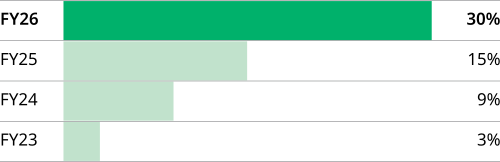
To support this strategic focus, AEL has established business-level, time-bound, and quantified targets aimed at increasing the contribution of sustainable products to overall revenues. As these businesses scale and mature – including the planned expansion of the copper smelting facility to 1 MMTPA and the development of green hydrogen capacity of up to 1 MMTPA along with downstream products, the share of revenue derived from sustainable products is expected to increase materially over the medium to long term.
% of Revenue from Sustainable Products
Strategic Integration with Energy Transition Pathways
AEL’s renewable manufacturing strategy supports integrated energy‑transition pathways, with solar and wind manufacturing as the core building blocks of low‑carbon energy systems. The Company is developing capacity of up to 10 GW of fully integrated solar PV modules and 5 GW of wind turbine generators to support renewable power deployment. In parallel, AEL is scaling its copper business towards up to 1 MMTPA, recognising copper’s role as a critical transition metal enabling electrification and clean‑energy value chains.
This scale‑up also underpins AEL’s ambition to support low‑carbon hydrogen value chains. The Company is establishing electrolyser manufacturing capacity of up to 5 GW, leveraging in‑house engineering capabilities, to enable infrastructure for up to 1 MMTPA of green hydrogen production, including downstream derivatives such as green ammonia and green methanol.
Strategy
The Sustainable Products Programme is supported through targeted investments in manufacturing infrastructure, process optimisation, and capacity expansion aimed at strengthening the sustainable products portfolio. In parallel, AEL conducts R&D toward product design improvements, efficiency enhancement, and lifecycle impact reduction, embedding sustainability considerations into technology development and innovation pathways.
Infrastructure upgrades and operational improvements are implemented to help ensure that products are manufactured sustainably, including enhancements related to energy efficiency, material optimisation, and environmental controls across manufacturing facilities.
To support effective implementation, AEL integrates internal training on sustainable design principles for functions involved in product development and delivery, including R&D, engineering, and technical operations. These programmes are intended to strengthen internal capabilities related to eco design, lifecycle thinking, and sustainable innovation.