Goals:
Achieve 50% reduction in water consumption intensity by 2030 w.r.t. FY 2021-22

Our Approach to Water Stewardship
We are committed to responsible water stewardship across all operating sites, focussed on minimising freshwater dependency, maximising reuse and recycling, and safeguarding shared water resources. Our approach combines establishing Zero Liquid Discharge (ZLD) systems, treatment of wastewater using ETPs/STPs, rainwater harvesting, and conducting periodic third-party assessments to identify opportunities for continuous improvement in water use efficiency. Regular R&D and innovation inform technology choices that advance our water stewardship goals. Aligned with our Water Management strategy, defined interventions are embedded within the ESG roadmap and systematically incorporated into budgeted projects of the respective businesses under AEL.
Water Risk Management
Water continues to shape AEL's long-term resilience, influencing operational continuity, regulatory preparedness, and stakeholder trust. As our businesses operate across diverse geographies, including water stressed areas, we recognise the significance of physical, regulatory and reputational water-related risks to our value-creation model. Insights from our enterprise-wide Water Risk Assessment reaffirm that these risks are not only environmental in nature but deeply linked to social expectations and future regulatory trajectories.
1) Governance and Accountability
Governance of water risk management, aligned with the broader ESG governance framework, is reinforced through robust Board and executive level oversight. This ensures that water risk considerations are fully embedded in AEL's strategic, operational, and investment decision-making, enabling proactive responses to evolving climate, regulatory, and community risks.
2) Identification and Assessment of Risks
We conduct enterprise-wide water risk assessments that blend globally recognised geospatial tools (e.g., WRI Aqueduct, WWF Water Risk Filter) with in-depth regulatory, economic, social, and infrastructure analysis at each operating location. This approach maps physical risks (water stress, seasonal and inter annual variability, depletion, supply-demand gaps) and transition risks (policy evolution, compliance expectations, infrastructure adequacy, community dynamics), highlighting current and future hotspots and vulnerabilities.
3) Risk Mitigation and Operational Controls
We prioritise measures tailored to local risk profiles especially in high water stress or vulnerable basins to reduce freshwater withdrawal, enhance circularity, and build long-term resilience:
- Zero Liquid Discharge (ZLD): Most operational sites are ZLD, evidencing process optimisation and closed loop water management.
ZLD implemented at 83% of sites
- Wastewater Treatment & Recycling: We manage effluents via on-site ETPs/STPs, recycling water for non-potable use to reduce freshwater withdrawal. Discharges are monitored continuously. Our management systems ensure that in the event of any incident, appropriate corrective actions are undertaken to ensure prompt containment and compliance.
12,37,951 kilolitres
of water recycled/reused in the reporting year
- Water efficiency and loss control: Water efficiency measures such as leak detection and repair programmes, and process optimisation drive responsible resource conservation and cost efficiency.
- Audits & Assurance: Internal and external experts conduct periodic water audits. A structured framework is implemented to identify, monitor, and prevent any breaches in wastewater treatment processes, including detailed assessments of wastewater treatment infrastructure, supported by regular maintenance and targeted employee training.
- Alternative and non-competing sources: To reduce dependence on freshwater and mitigate sourcing risks, we increasingly obtain water from non-competing sources (e.g., desalinated water, treated wastewater).
46%
of total water sourced from non-competing sources in the reporting year
- Rainwater harvesting and recharge: We prioritise rainwater harvesting to replenish groundwater and reduce reliance on conventional supplies, wherever feasible.
- Community and watershed stewardship: Recognising water as a shared resource, we integrate risk management and shared value creation to reinforce operational resilience, cost prudence, and our social licence to operate.
We work with local governments, NGOs, community groups, and employees on inclusive conservation and recharge projects, while using local/social media for awareness, thereby strengthening community water security and climate resilience.
Key Community Water Initiatives
For more info, please refer to the Corporate Social Responsibility Section
4) Performance Monitoring and Reporting
We have established quantitative, risk-based targets to reduce freshwater dependence, increase circularity through reuse and recycling, and improve resilience in water-stressed regions. Insights from risk assessments inform capex decisions, technology adoption, and engagement with communities and regulators. We emphasise transparent disclosure and continuous improvement in how we assess, manage, and communicate water related risks.
Water Positive Operations
Our water stewardship ambition extends beyond operational efficiency to advancing water positivity in regions where we operate. By reducing freshwater withdrawals, maximising recycling and reuse, sourcing water from non-competing sources, and investing in rainwater harvesting and watershed interventions, we aim to replenish more water than we consume in priority locations over time. These efforts are informed by our enterprise-wide water risk assessment, with particular focus on water-stressed and vulnerable basins and are complemented by community-centric recharge and conservation initiatives. Through this integrated approach, we seek to strengthen long-term water security for ecosystems and communities while enhancing the resilience and sustainability of our operations.
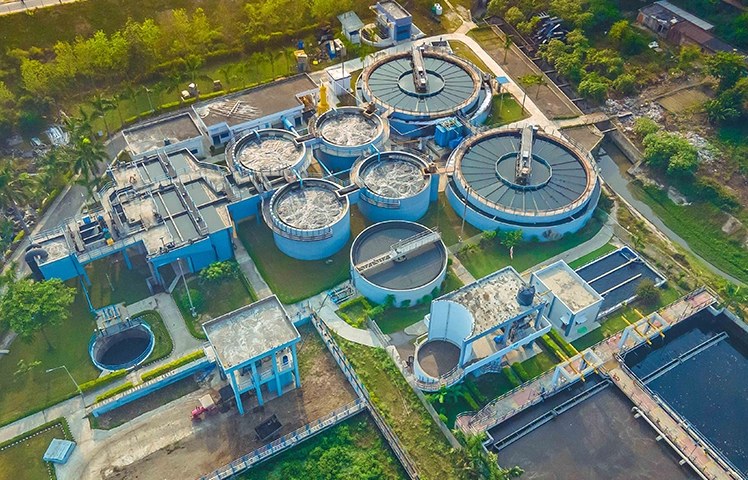
Adani Water Ltd., Prayagraj
Water Stewardship Through Digital Transformation at Adani Airports
Adani Airports Holdings Limited is strengthening water stewardship across its airports by leveraging digital and AI-enabled solutions to optimise water use and enhance wastewater treatment efficiency. As operations scale, technology-led interventions play a critical role in reducing water intensity and advancing water-positive outcomes.
At Ahmedabad Airport, a cloud-based smart irrigation system has been deployed across 17 acres of landscaped areas. Using sensors, automated controls and real-time weather and evapotranspiration data, the system enables precise, need-based irrigation. This has resulted in an estimated annual water saving of ~17,850 KL while improving landscape health and operational efficiency through remote monitoring.
At Thiruvananthapuram International Airport, an AI-powered Wastewater Intelligence System optimises treatment processes through real-time monitoring and advanced analytics, delivering 20–30% operational savings while consistently maintaining high water quality standards.
Together, these initiatives demonstrate how digital innovation can drive efficient water use and wastewater management, reinforcing Adani Airports' commitment to sustainable infrastructure, water positivity and operational excellence.
Progress Against Key Metrics
Water Withdrawal, Discharge and Freshwater Consumption (in kilolitres)
| Particulars | FY 2025-26 |
|---|---|
| Water withdrawal (excluding seawater) | 52,30,048 |
| Water discharge (excluding seawater) | 2,83,175 |
| Total net water consumption (excluding seawater) | 49,46,873 |
In FY 2025-26, AEL recorded 75% reduction in the water consumption intensity7
Water Consumption Intensity (Organisation-Wide)
(kilolitre per ₹ crore of revenue)
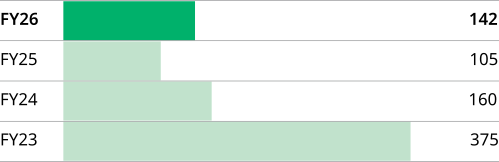
7 Base Year FY 2021-22 with 562 kilolitres per ₹ crore of revenue as water consumption intensity
We have witnessed an increase in water consumption, owing to business expansion and the addition of a new terminal in the Guwahati Airport.